How to Show Up in ChatGPT in 2026: A Guide for Startups
Showing up in ChatGPT comes down to three things: publishing on-site content, fixing crawlability roadblocks, earning off-site citations Anagram helps you do all three!

By Zach Luker, GEO Researcher at Anagram Published May 29, 2026 · Last updated May 29, 2026
TL;DR
Showing up in ChatGPT comes down to three things: publishing on-site content structured the way ChatGPT actually reads (Q&A headers, atomic answers, comparison tables), fixing the crawlability roadblocks that block AI from reading it, and earning citations in the off-site sources ChatGPT already trusts. Startups that treat all three as one always-on loop — measure, act, re-measure — outperform startups that pick one and ignore the others.
Why "showing up in ChatGPT" is different from SEO
ChatGPT does not rank ten blue links. It synthesizes one answer and names a handful of sources. The win condition is being quoted or cited inside the answer, which the industry now calls share of synthesis or Generative Engine Optimization (GEO).
The shift is happening fast. Gartner forecasts a 25% decrease in traditional search volume by 2026 as users move to conversational assistants. ChatGPT alone now handles over 1 billion daily queries and holds roughly 81% of the chatbot market.
For startups, the implication is that the traditional content playbook — write 2,000-word SEO articles, build backlinks, wait six months — produces diminishing returns when the buyer is asking ChatGPT instead of Google. GEO requires a different structural approach to content, a different technical foundation, and a different distribution strategy.
How does ChatGPT decide what to cite?
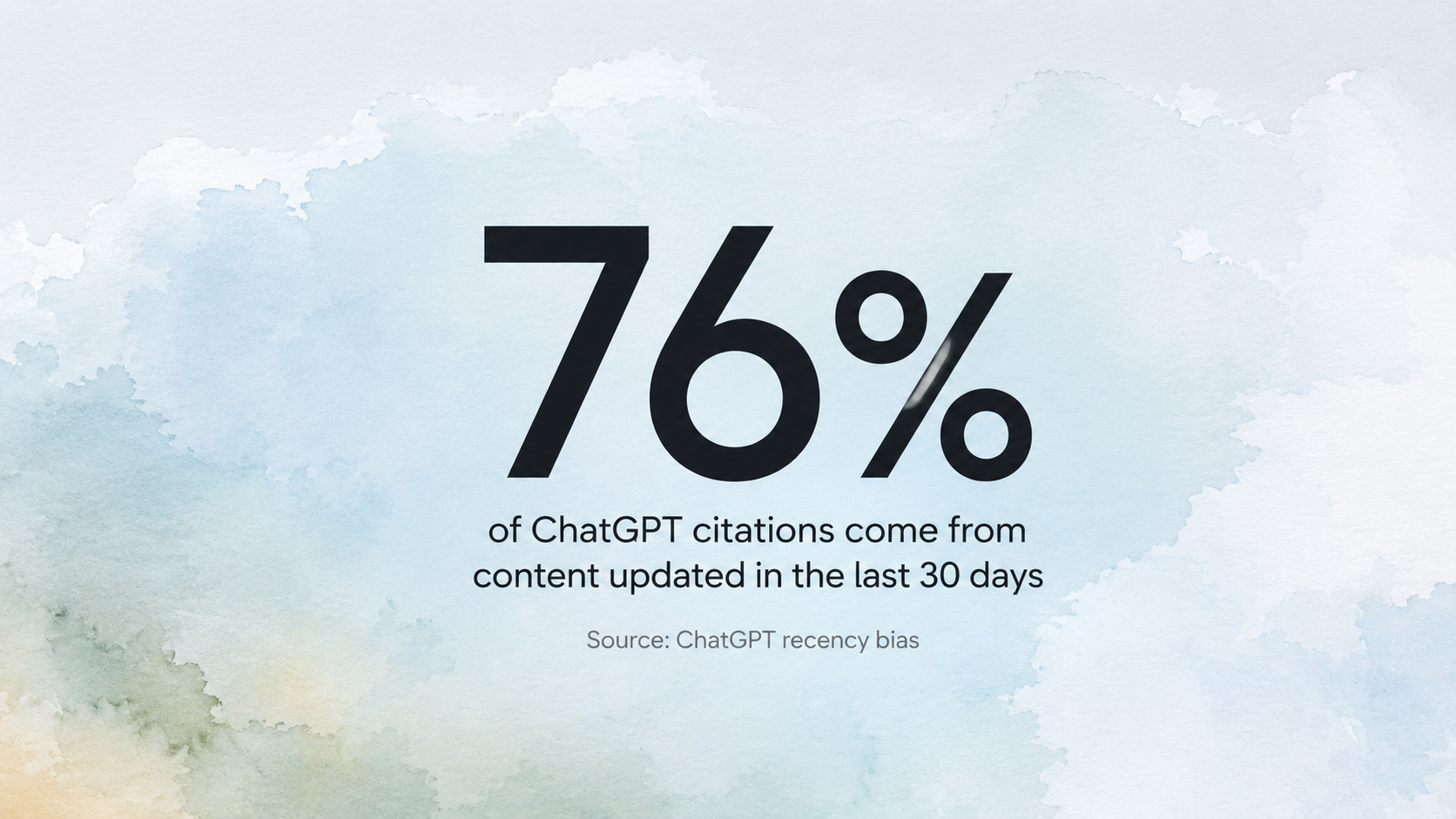
ChatGPT prefers a small number of authoritative, recent, well-structured sources. Citation studies show the top-cited domains include Wikipedia, Reddit, LinkedIn, Forbes, G2, TechRadar, and major news publishers — but a meaningful share of ChatGPT citations also point to well-structured brand-owned pages. ChatGPT shows a strong "big brand bias" combined with a recency bias — roughly 76% of its citations come from content updated in the last 30 days.
Three signals matter most:
Structural parseability. ChatGPT lifts answers from pages that look like reference material — clean Q&A headers, 40–60 word direct answers, comparison tables, attributed statistics. Long flowing paragraphs and JavaScript-rendered content perform worse.
Crawler access. If OAI-SearchBot can't reach a page, none of its other qualities matter. OpenAI's documentation states that sites which block OAI-SearchBot will not appear in ChatGPT search answers at all.
Third-party validation. ChatGPT also pulls heavily from what other authoritative sources say about a brand. A Forbes mention or a top G2 review reinforces the on-site signals; without it, owned content competes harder.
The three pillars of showing up in ChatGPT
There's no single lever. The startups that win are working on three things in parallel:
PillarWhat it coversWhy it mattersOn-site contentGuides, blog posts, FAQs, comparison pages, landing pages structured for AI retrievalThe most controllable lever. Brands directly own the content and the format.Crawlabilityrobots.txt, CDN/firewall rules, JavaScript rendering, schema, sitemapsEven perfect content is invisible if AI crawlers can't read it. Otterly found 73% of sites have technical barriers blocking AI crawlers.Citations & third-party sourcesReddit, YouTube, G2, LinkedIn, Wikipedia, industry publications, listiclesChatGPT trusts third-party validation. Off-site mentions compound on-site work.
The next sections walk through each pillar with the specific actions a startup can take.
Pillar 1: How do I create on-site content that ChatGPT will cite?
Owned content is the most controllable GEO lever, and it's where most startups should start. The structural conventions matter more than total word count or topic breadth — a tightly written 1,200-word guide built the right way will outperform a 3,000-word SEO-style post.
What "the right way" means in practice:
Use Q&A-styled headers. Every H2 should be a question a real buyer would ask AI. "How does X work?" not "Understanding X." "What's the best X for Y?" not "Choosing X." Headers that literally match user prompts are dramatically more retrievable.
Lead each section with a 40–60 word direct answer. Profound's research suggests this is the optimal length for the chunk AI systems lift verbatim into answers. No throat-clearing — first sentence is a complete standalone answer.
Write in atomic chunks. Each paragraph covers one idea and stands alone. Long flowing paragraphs that mix three concepts are harder to retrieve as useful chunks.
Build around guides, not blog posts. Guide-style content has shown the highest average citations among page types, and clean URLs outperform URLs with query strings or tracking parameters. If a startup has bandwidth for one type of content, it should be evergreen guides.
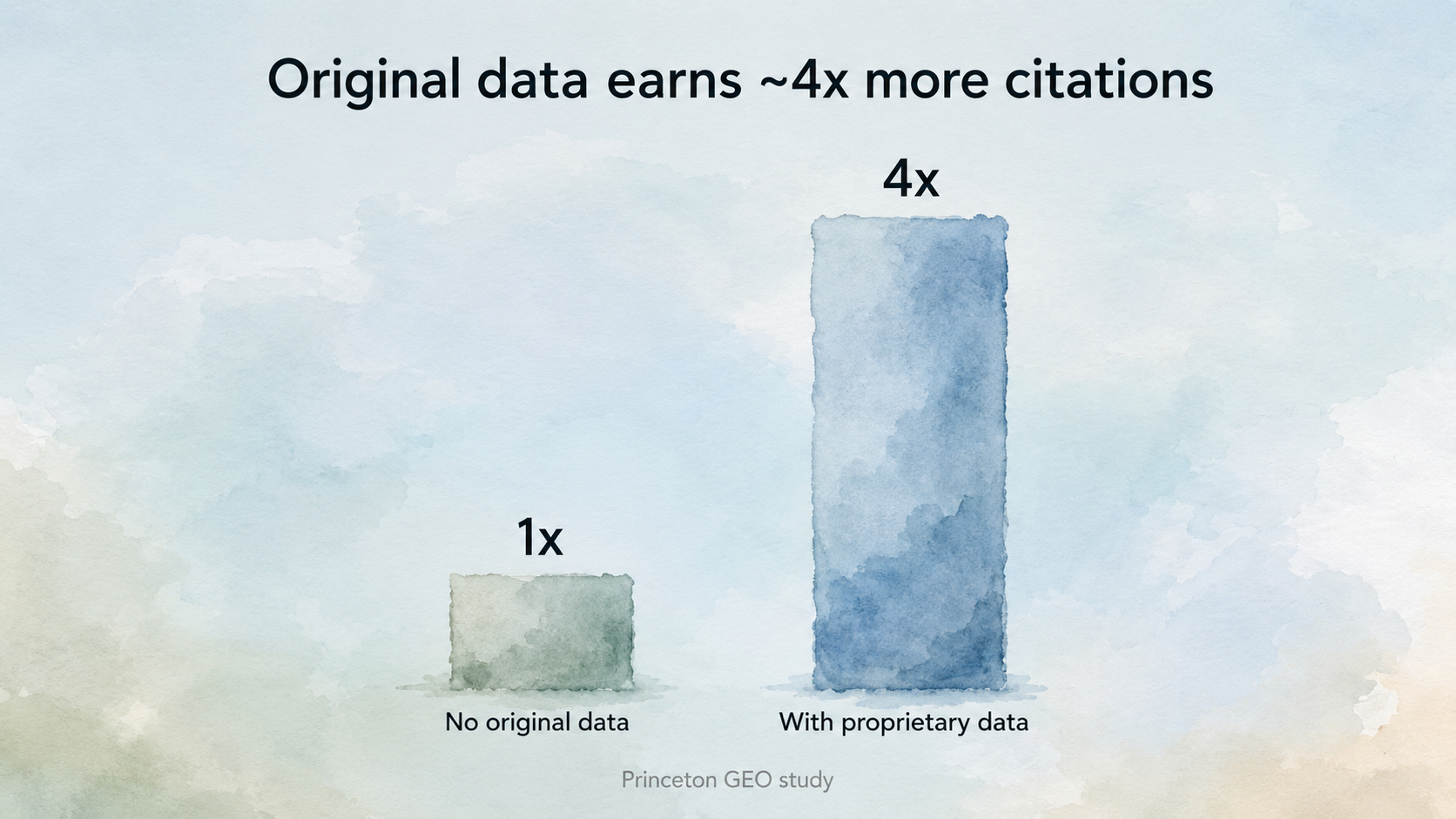
Include proprietary data and named statistics. Original research and benchmark data receive roughly a 4x citation multiplier compared to content without them, per the Princeton GEO study. A single original chart with a quotable takeaway can carry an entire article.
Refresh existing pages before publishing new ones. Scrunch analyzed 3.5 million citation events and found citation activity drops by half in about 4.5 weeks on average — and only 3.4 weeks for ChatGPT. Updating high-traffic pages quarterly (or monthly for top pages) often beats publishing new ones.
Pillar 2: How do I fix the crawlability roadblocks blocking AI from reading my site?
Crawlability is the technical foundation underneath everything else, and it's the most commonly broken. Otterly's 2026 citation report found that 73% of sites have technical barriers blocking AI crawler access — robots.txt issues, CDN restrictions, JavaScript rendering problems. A startup with perfect content and a blocked crawler is invisible.
The roadblocks that matter most for ChatGPT visibility:
robots.txt misconfiguration. OpenAI explicitly recommends allowing OAI-SearchBot for ChatGPT search visibility — and states that opted-out sites won't appear at all. Many startups accidentally block search crawlers when they meant to block only training crawlers. The two are separate decisions.
CDN and bot-protection rules. Cloudflare, Akamai, Vercel, and similar tools often classify AI crawlers as bots and challenge or rate-limit them. Legitimate AI agents need explicit allow-rules. Rate limits set too aggressively prevent enough pages from being crawled.
JavaScript-rendered content. Vercel and MERJ's research found that AI crawlers behave differently from Google's renderer — many AI systems do not execute JavaScript the way Google does. Content that loads client-side may be visible to humans, visible to Google, and invisible to ChatGPT. This includes FAQs, pricing tables, and reviews hidden inside SPAs.
Structural issues that limit parseability. Important content buried in tabs, modals, or accordions; weak heading hierarchy; missing schema (Article, FAQPage, Product); messy URLs with query strings; and missing or stale sitemap entries all reduce how much of a page AI systems can actually use.
The right cadence is to treat crawlability as a recurring diagnostic, not a one-time setup checklist. Sites change, CDN rules update, and new pages introduce new blockers.
Pillar 3: How do I earn citations in the sources ChatGPT already trusts?
Owned content does most of the heavy lifting, but ChatGPT also leans hard on third-party validation. Peec AI analyzed 30 million citation sources across ChatGPT, Google AI Mode, Gemini, Perplexity, and AI Overviews. Reddit and YouTube appeared across all five platforms. ChatGPT specifically leaned toward Wikipedia, Forbes, TechRadar, Reddit, and LinkedIn.
The five channels that matter most for startups:
ChannelWhy it matters for ChatGPTStartup actionRedditHigh citation frequency; ChatGPT pulls authentic discussion threads as user-perspective sourcesMonitor relevant subreddits; reply as a peer (not a brand) when the topic genuinely fitsYouTubeUnderweighted by ChatGPT (<1% of citations) but heavily weighted by Gemini (~25%); cheap to testPublish category explainers and product demos; even unpolished videos accrue authority over timeG2 / review platformsHigh-trust third-party validation; ChatGPT cites G2 frequently for "best X" promptsClaim and complete your G2 profile; run targeted review-request campaigns to loyal customersLinkedInHeavily cited; founder and operator voice carries weightPublish from founder and team accounts on category-relevant topics, not product launchesWikipediaHigh-authority source for ChatGPT specifically; hard to qualify but durable when earnedWorth pursuing once the brand has enough independent press coverage to meet notability standards
One Otterly experiment found that a brand-new YouTube channel with zero subscribers, zero watch history, and no paid promotion published 25 AI-generated videos and lifted ChatGPT share of voice by 38% across the tracked prompt set within a week. Channels are cheaper to influence than most teams assume.
Beyond these five, the broader citation landscape includes editorial publications, listicles, buyer guides, directories, marketplaces, and analyst pages — the kinds of sources AI pulls from when answering "best tools for…" or "X vs Y" prompts.
How does Anagram help startups run all three pillars?
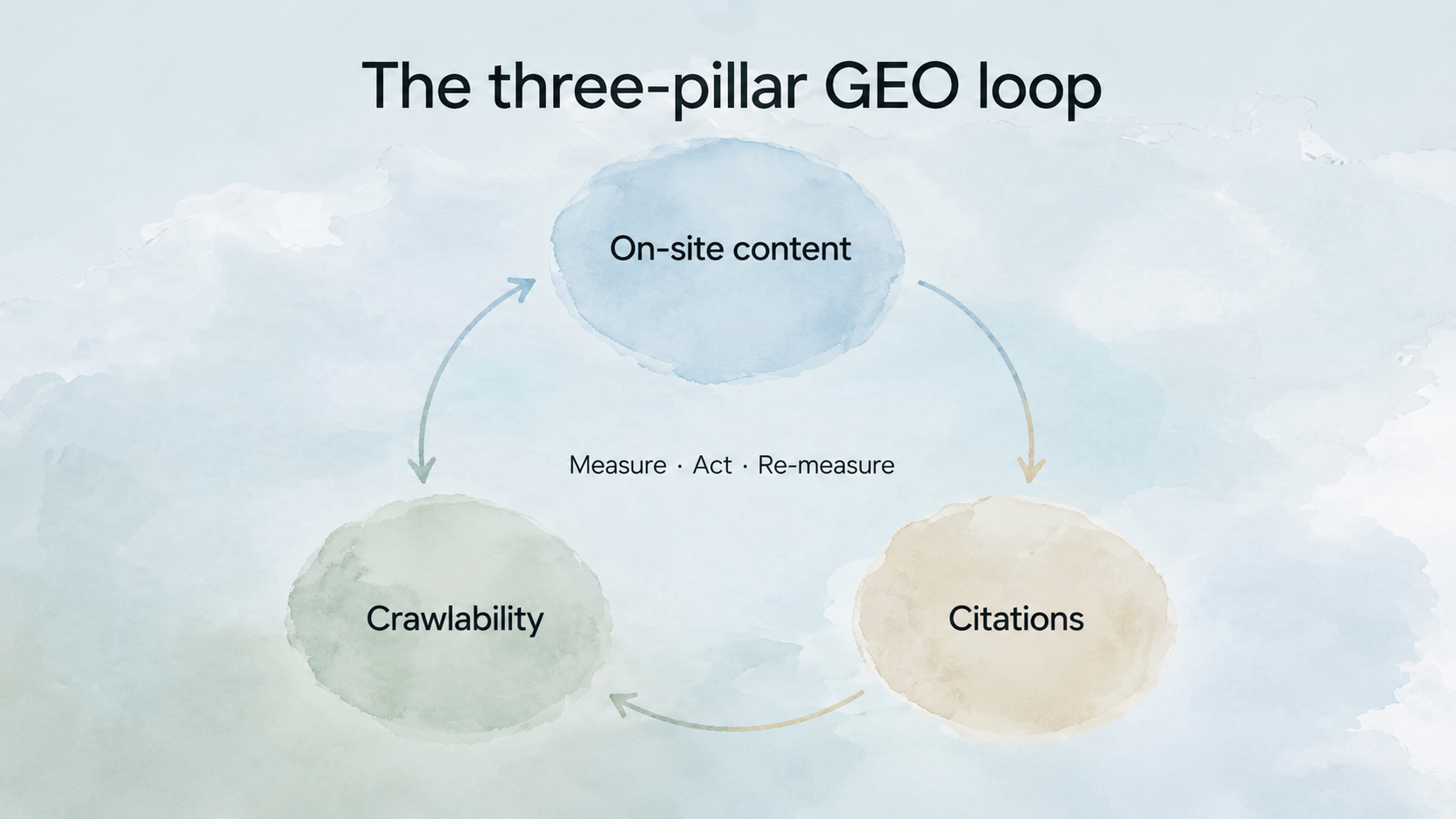
Anagram is built around the loop the three pillars require: measure where you're invisible, act on the highest-leverage gap, re-measure. It covers monitoring, on-site content, crawlability, and off-site citation work as one connected system rather than three separate tools.
Monitoring AI visibility. Anagram tracks which prompts a brand surfaces for in ChatGPT (and Perplexity, Gemini, Google AI Overviews) and which it doesn't. The dashboard shows share of voice, which competitors are cited in your place, and how those positions shift over time.
Discovering the citations AI is using. For every tracked prompt, Anagram surfaces the exact sources ChatGPT is citing — competitor pages, Reddit threads, G2 listings, YouTube videos, Wikipedia entries, industry publications. This is the data that tells startups which pillar to work on first.
On-site content. Anagram identifies prompt gaps where no page on the site directly answers the question, generates GEO-optimized drafts that follow the structural conventions ChatGPT favors (Q&A headers, atomic answer chunks, comparison tables, named statistics), and flags existing pages that need refreshes before their citation half-life expires.
Crawlability diagnostics. Anagram surfaces the technical blockers preventing AI systems from reading the content you publish — robots.txt issues, JavaScript-rendering gaps, schema problems, and CDN/bot-protection misconfigurations — so on-site work isn't wasted.
Off-site citations. Anagram helps draft the Reddit replies, YouTube scripts, G2 review outreach, LinkedIn posts, and Wikipedia-ready drafts that earn placement in the off-site sources ChatGPT cites. Some of this work is productized today and some is delivered as a service to early customers — the goal is a single system that closes the gap regardless of which channel matters most for a given prompt.
The category includes other tools — Profound, Scrunch, Otterly, Peec, and Noble, among others — and they're real alternatives. If the bottleneck is dashboards and analytics depth, Profound or Scrunch are reasonable choices. If the bottleneck is third-party citation acquisition specifically, Noble specializes there. Pick the tool that solves your actual bottleneck.
How long does it take a startup to show up in ChatGPT?
Faster than most teams assume. The first published benchmark on this question comes from Josh Blyskal at Profound, who analyzed roughly 900 newly published marketing pages across billions of LLM response logs. Median time to first citation was 6.81 days. The 90th percentile landed at 37.10 days — meaning half of well-structured new pages get cited within a week, and 90% are cited inside about five weeks.
Semrush ran a similar experiment and saw a comparable curve for ChatGPT specifically: eight of 81 test pages (10%) got cited immediately the day after publication, 14 pages after a week, 28 pages after two weeks, and 34 pages (42%) by day 30. ChatGPT was slower to start citing content than Google AI Mode, but once it did, the pages that got cited retained those citations and new pages kept being added.
The timeline breaks down roughly like this:
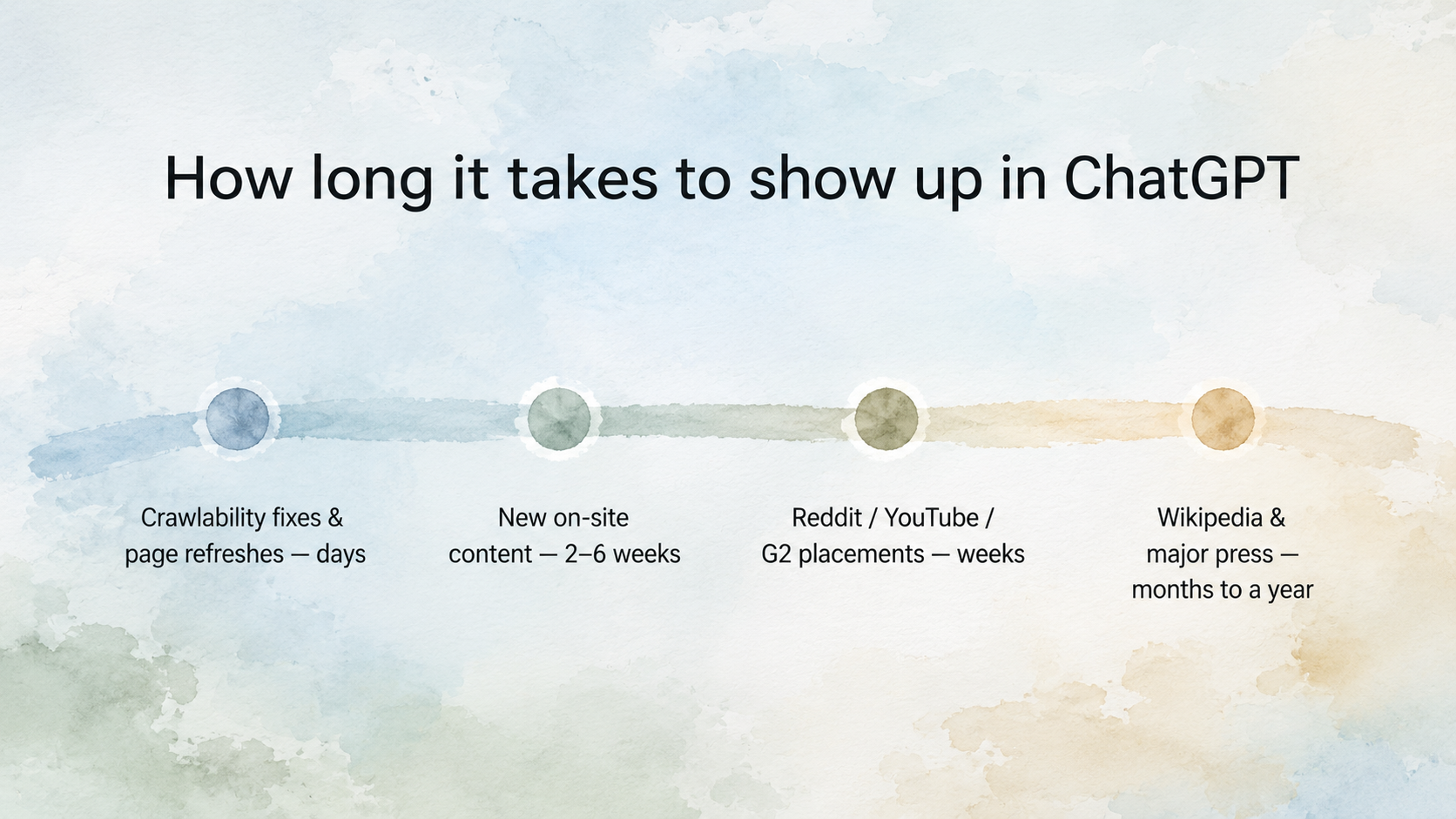
Days, not weeks: Crawlability fixes (allowing
OAI-SearchBot, fixing JavaScript-rendering issues, repairing schema) — these unblock content that already exists.~1 week (median): First citations on well-structured new on-site content, per Profound's benchmark.
~5 weeks (90th percentile): Most well-structured pages have earned their first citation by this point. If a page is past day 37 with no citation, the problem is almost certainly not that you need to wait longer — it's structural or technical, and it's fixable.
Weeks to months: Off-site citations from Reddit, YouTube, and G2 placements.
Quarters to a year: Wikipedia and major-publisher mentions in competitive categories.
One important caveat: these timelines assume ChatGPT's web-search mode, which retrieves content in real time. Base-model ChatGPT without web search has a training cutoff and doesn't incorporate new content between model releases — that timeline is measured in months to over a year. There is no shortcut for it; it's an architectural constraint. For most buyer queries today, web search is active, so the 7-to-37-day window is the relevant one.
Citations also decay, so the work doesn't end. Scrunch's 4.5-week average citation half-life means a content cadence and a monitoring loop are both required to maintain visibility once you earn it.
Frequently asked questions
Is GEO different from SEO?
Yes. SEO optimizes for ranking in blue links; GEO optimizes for being cited inside AI-generated answers. The tactics overlap (high-quality content, clean structure, authoritative sources) but the highest-leverage moves differ. SEO rewards backlinks and keyword targeting; GEO rewards original data, expert quotes, Q&A structure, and third-party citations.
Do I need to allow AI crawlers in robots.txt?
For ChatGPT search visibility specifically, yes — OpenAI's documentation recommends allowing OAI-SearchBot, and sites that opt out will not appear in ChatGPT search answers. Training crawlers (GPTBot, ClaudeBot, Google-Extended) are a separate decision; many brands allow search crawlers while restricting training crawlers.
Can a small startup compete with big brands in ChatGPT?
On long-tail prompts, yes. ChatGPT's big-brand bias makes head terms ("best CRM software") hard to win against incumbents, but specific prompts ("best CRM for solo founders in regulated industries") are winnable through targeted owned content plus a few well-placed third-party mentions. Most startup GEO programs should start in the long tail.
Should I prioritize on-site content or off-site citations first?
Crawlability first (it's a prerequisite for both), then on-site content (it's the most controllable lever), then off-site citations (they compound on-site work). Most startups should not invest in Reddit, YouTube, or G2 outreach before their owned site is structurally GEO-ready, because the on-site pages are what those off-site citations link back to.
How often should I refresh content for ChatGPT?
Citation activity drops by half in roughly 3.4 weeks for ChatGPT specifically, per Scrunch's analysis. A monthly refresh cycle for high-priority pages is a reasonable baseline; weekly for the top five to ten priority pages.
Does AI-generated content hurt ChatGPT citation chances?
Not directly — ChatGPT cites well-structured, factually dense content regardless of whether a human or AI drafted it. What hurts is generic, low-information content with no proprietary data, no expert attribution, and no original perspective. AI-generated content that fails on those dimensions performs poorly; AI-generated content that includes them performs fine.
Sources
Gartner — "Gartner Predicts Search Engine Volume Will Drop 25% by 2026" (2024)
Scrunch — "The Half-Life of AI Citations" (2025): https://scrunch.com/blog/half-life-of-ai-citations
Otterly — "The AI Citations Report 2026": https://otterly.ai/blog/the-ai-citations-report-2026/
Otterly / TRYSEO — "GEO Experiment: YouTube AI-Generated Videos": https://otterly.ai/blog/geo-experiment-youtube-ai-generated-videos/
Peec AI — Analysis of 30 million citation sources across ChatGPT, Gemini, Perplexity, Google AI Mode, and AI Overviews (2025)
OpenAI — Bot and crawler documentation, OAI-SearchBot guidance
Aggarwal et al. — "GEO: Generative Engine Optimization," Princeton (2024)
Vercel & MERJ — Research on AI crawler JavaScript rendering behavior (2024)
Blyskal, Josh — "Time-to-Citation for ChatGPT and Claude" (Profound, 2026): median 6.81 days, 90th percentile 37.10 days, n≈900 pages
Semrush — "How Fast Do AI Search Platforms Cite New Content?" (2025): https://www.semrush.com/blog/how-fast-do-ai-search-platforms-cite-new-content/
AuthorityTech — "How Long Does Earned Media Take to Appear in AI Search Citations?" (2026): https://authoritytech.io/blog/earned-media-ai-citation-timeline-2026